About 42 miles north of Big Bend National Park, you’ll find a sleepy, dusty town at the foot of the Glass Mountains. Marathon, Texas is small by any measure — about 400 residents, a few blocks of homes, and not one single traffic light, only stop signs. It is, in every sense, in the middle of nowhere. If you want to visit Marathon, you’ll have to try. And today, I’m trying.
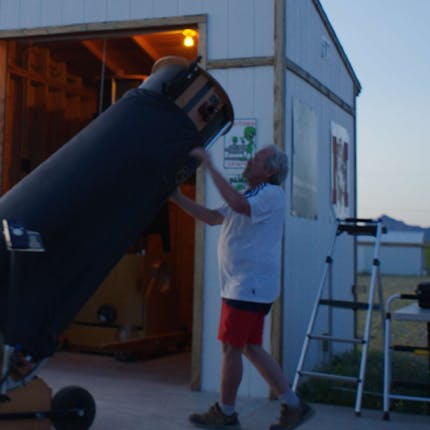
I’m staying at Marathon Motel and RV Park. I’m here to meet Bill Ramey, an amateur astronomer and full-time RV resident at the park. Don’t let “amateur” throw you off, though. Bill has forgotten more about astronomy over the past week than most of us will learn in a lifetime. According to the astronomers at the world-renowned McDonald Observatory just to the North in Fort Davis, he’s a legend. But Bill describes himself — and his passion — more modestly.


“When I was 6, my older brother got a telescope for Christmas,” he recalls. “He lost interest quickly, but I picked it up and began looking at the night sky. With my mother’s help, I chose several books about astronomy, celestial physics, and then later, I studied mechanical physics, and here I am.” He gestures with open arms towards the motel’s patio. There’s nowhere he’d rather be.
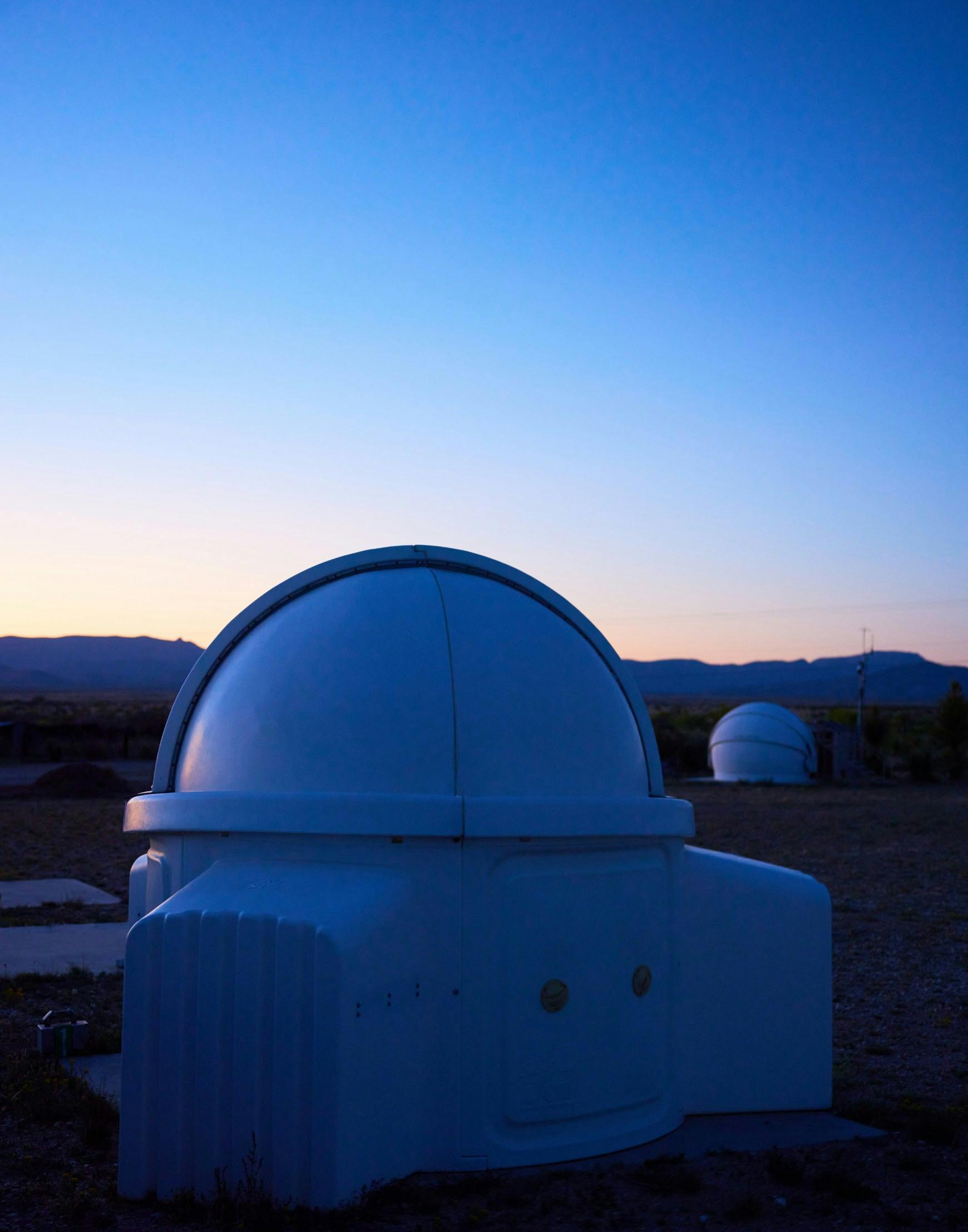
By “here,” Bill’s referring to the Park where he arrived over six years ago in his RV. He has invited me to one of the nightly star parties he hosts once the sun goes down. I’m not alone, either. There’s a couple from Pennsylvania. Another toting their own monstrosity of a telescope from Los Angeles. And three friends who have made the 3-day drive from D.C. — all of them to see the stars.

“It’s going to be FANTASTIC,” he says with a big grin. It’s a smile that reflects how passionate he’s become about this place and how much he loves the stars.
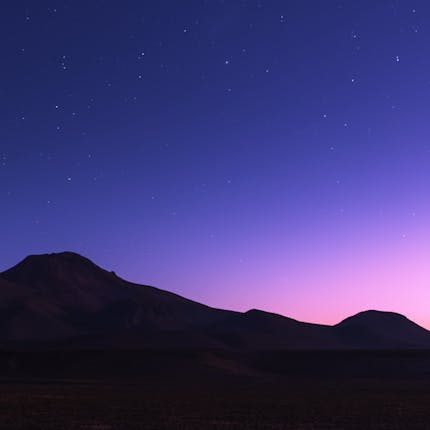
Because while you won’t find a big population in Marathon or the slightest pulse of a nightlife, what you’ll discover here in abundance is darkness. And stars. This is both by nature and by design. Marathon sits right in the middle of a dark sky preserve. These areas are essentially devoid of light pollution — the incessant glare from cities and towns that obscures the cosmos. And only 201 of them exist on Earth. What makes Marathon particularly noteworthy is its distinction as a Class 1 Dark Sky. The best of the best. Visitors from around the world travel thousands of miles to see the cosmos here. Astronomers come here to study them. In fact, I’m informed that a NASA researcher is staying two doors down from me.
Preserving Our Last
Natural Resource
Preserving Our Last
Natural Resource
The ocean, the forest, the air — conservation movements abound, and they’re moored by conservationists dedicated to them. Bill and his counterparts see our dark skies in much the same way: a dwindling resource threatened by human development. Bill talks about LEDs in a tone laced with complete disdain. Our phones, tablets, televisions, headlights, porch lights, and now even streetlights are all culprits. The movement to LEDs might be more economical, but it’s wreaking havoc on our mental health and our ability to see and ponder the cosmos — an act that’s been hardwired into us over millions of years. With more screens creeping into our lives, the more stars are disappearing. And I can’t help but think that a part of our imagination is fading with them.
Marathon passed its own Dark Sky Ordinance in the last few years. The ordinance requires residents to direct outdoor lighting over 200 lumens towards the ground. “Light trespassing,” where one property’s light shines onto another, is also prohibited. If residents don’t comply, they can face daily fines.

DARKNESS DISAPPEARS AT THE SPEED OF LIGHT
DARKNESS DISAPPEARS AT THE SPEED OF LIGHT
Bill turns on an overhead patio light, demonstrating how light floods the surrounding landscape. “Darkness disappears at the speed of light,” he reveals. He quickly flicks it back off again as darkness begins to settle in — it’s almost time for the star party. I’m starting to see what makes this place and its sky so special. I’m used to picking out a few stars at home or a constellation or two if I’m lucky. It’s not even completely dark in Marathon and the cosmos is beginning to light up. If weather permits, Bill says we’ll be able to see over 4,000 stars tonight — and that’s without a telescope. “We're educating people. When somebody parks near me, I go out and greet them. I invite them to the star party, and I just tell them that this is a Dark Sky Area, and we really appreciate everybody pulling their shades at night and keeping their outdoor lights off. And generally, I would say 99% of people do that. But it's an education because they come from the cities, and they're so used to the light.”
The Orion Nebula, Zodiacal Light, and a Party to Remember
The Orion Nebula, Zodiacal Light, and a Party to Remember
I make my way to the star party as the sun finally sets behind the desert. We can hear the coyotes begin to howl somewhere beyond us, but everyone is transfixed on the sky unfolding overhead. Bill repeatedly instructs to turn off cell phones and headlamps. And the party starts.
It’s hard to put into words. The cosmos is so visible that Venus almost becomes a source of light pollution. Before long, Mars appears, then Orion followed by the Dippers. There are countless stars, more than I’ve ever seen in my life. But there is depth there too – the distant nebulae illuminated by the surrounding stars look like small clouds.
“Look at those puppies!” Bill shouts with an eye to his telescope. He has it trained on the Orion Nebula and invites me over for a look before stealing one last glance. He can’t help himself, and it’s hard to believe he does this, weather permitting, almost every single day of the year. “Would you look at that,” he repeats.
Holding my eye up to the telescope, the nebula comes to life. It looks like a bird with spread wings. When I look beyond the nebula, I don’t just see stars. I see thousands of them. Stars stacked on stars. Nebulas. As I peel my eye away from the telescope to let another guest have a turn, I look again at the sky and see the bands of the Milky Way stretched out in front of me. It’s hard to put it all into perspective, but Bill tries anyway.
UNRAVELING THE COSMOS
UNRAVELING THE COSMOS
“Nuclear fusion is constantly occurring in the core of every star,” he explains. “The Orion Nebula we’re looking at – that light takes 1,400 years to get here. The sunlight that we see during the day originated in our sun’s core more than 10,000 years ago as a result of nuclear fusion. And when you take a photograph with the long exposure, you get to see all these wonderful colors – the reds and violets – that come from the different gasses each star is burning.”
For dark sky advocates like Bill, light is a story told in darkness. And while the patterns of the earth’s rotation are predictable, we’ve barely scratched the surface when it comes to unraveling the cosmos. Bill starts pulling one thread and then another. “You start small. Maybe you learn three constellations and then, bam!, all of the sudden you see what’s around them: the nebulae, open clusters, closed clusters, globular clusters, galaxies that are beyond our own galaxy.”

“What’s that?” a visitor asks, pointing towards the western horizon where the sun had long since set. There’s a faint triangular glow framing the mountains, and Bill gestures towards it with open arms in an act of enthusiasm and glee. He turns the question back on us. “What do YOU think it is?” He asks.
“LA?” the friends from D.C. guess.
“Las Vegas?” The couple from Pennsylvania venture.
This is what Bill was hoping for. We’ve taken the bait. He knows we’re too far from any source of light pollution. Now he’s going to set the hook.
“That, my friends, is Zodiacal Light,” he declares. His maniacal laugh is contagious and we all start smiling.
Zodiacal light is, according to Bill and many other astronomers, the rarest light you can see from earth. Rarer than the Aurora Borealis, and it’s only visible in a Bortle 1 or 2. The faint elongated cone of light could be mistaken for a distant city, but it’s actually the sunlight reflecting off interplanetary dust and ice within the plane of our solar system. I squint as Bill outlines the triangle with his laser pointer, “Magnificent,” he says to himself like he just unearthed a mint condition 1952 Mickey Mantle.

PRESERVING THE WONDER
PRESERVING THE WONDER
“We need darkness to sleep correctly,” he says. “The more we surround our lives with blue light, the more anxious we become. The more aggressive we become. But it’s not just us. A large percentage of animals are nocturnal. In a very real sense, these animals can only survive because of darkness. Kill the darkness, kill the animals.”
Listening to Bill’s zealousness, he might seem like a prophet crying from the desert, but his theories are rooted in science. According to research by the University of California, Davis, blue light exposure interrupts our circadian rhythm, which can lead to diabetes and cardiovascular disease. And in a world where adults are averaging nearly three hours on digital devices a day, that’s a real danger.
But advocates for dark sky zones like Bill will also say that above the dangers, it’s the wonder they’re afraid of losing. The power and magnetism of seeing the swath of the cosmos spread before you. Of looking at the Orion Nebula or beyond our galaxy. Of wondering like our ancestors and those before them about where we came from and where we’re headed. Giving all of that up is a price too big to pay. That’s why places like Marathon still exist. It’s why people like Bill are still fighting to keep them this way — to preserve a part of our humanity that’s disappearing behind pixels.
“People aren’t venturing away from cities anymore,” Bill says, adjusting the telescope to new coordinates. It’s late now and cold. Most of the star party attendees have drifted back to their hotel rooms. “We live in these cocoons of light without ever experiencing something like this. That’s why I do it. I love seeing people experience this for the first time. The look in their eyes is what keeps me here.”
Marathon Motel and RV Park is silent except for a few stragglers still slowly panning the telescopes back and forth, not wanting to trade these stars for the inevitable dawn. Bill types new coordinates into a telescope and looks into the eyepiece.
“How do you even begin to understand all of this?” I ask.
But he’s already a hundred thousand light years away, his thoughts diffusing light and color into the Marathon night and the cosmos above us.
“Amazing,” he says.
To book a trip to or attend a star party at the Marathon Motel & RV Park, head to MarathonMotel.com. To learn more about Dark Sky Zones, head to DarkSky.org, Go-Astronomy.com, and DarkTexasSkies.com